
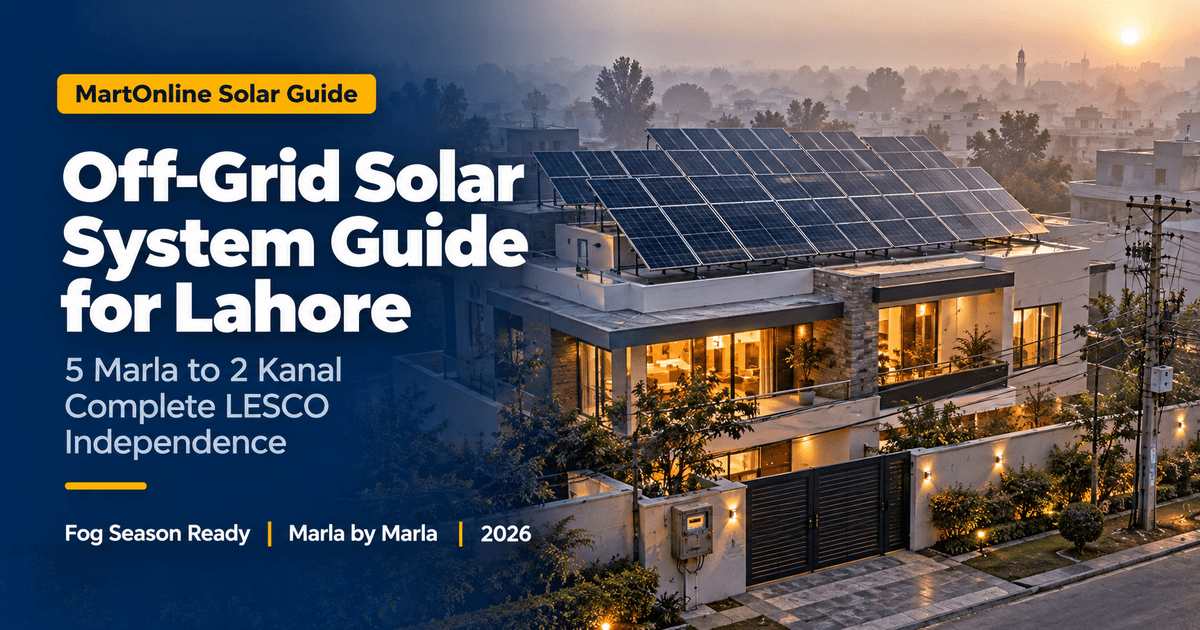
Off-Grid Solar System Guide for Lahore — Complete LESCO Independence by Marla Size
Complete off-grid solar system guide for Lahore homes. Marla-by-marla inverter and battery sizing from 5 marla to 2 kanal. Built for Lahore fog season and high-loss LESCO areas in Shahdara, Mughalpura, Tajpura and surrounding districts.
30 min read
If you live in Shahdara, Tajpura, Mughalpura, Harbanspura, Awan Town, Batapur, or any other area of Lahore where LESCO cuts power for 4 to 8 hours every day in summer and then disappears for entire nights in January fog, a standard hybrid solar system with 4 hours of battery backup is not the answer. You need something more fundamental — a system that makes LESCO irrelevant.
An off-grid solar system gives you complete energy independence. Your home runs entirely on solar panels and battery storage. LESCO becomes something you no longer think about. No load shedding schedule to check. No unannounced outages in the middle of summer heat. No monthly bill rising every quarter. Your electricity comes from your roof, stored in your batteries, available whenever you need it.
This guide is written specifically for Lahore homeowners who are done waiting for LESCO to fix its aging distribution system. It uses marla as the property size measurement because that is how Lahore homes are measured — not gaz. It names your neighbourhoods. It accounts for the one factor that makes Lahore off-grid design uniquely challenging: the winter fog season, when solar generation can drop 30 to 50 percent for weeks at a stretch, not just a few cloudy days. And it gives you exact system sizes, battery counts and panel numbers grounded in real data, not generic guides that ignore Lahore's specific climate realities.
If you are in a low-loss LESCO area like DHA Lahore, Bahria Town or Johar Town with only 2 to 4 hours of daily load shedding, our hybrid solar system guide for Lahore may be a more cost-effective solution for your situation. This guide is for homeowners who need 8 to 14 hours of daily energy independence — or who want to cut their relationship with LESCO completely.
Is Off-Grid Solar Right for You?
Before sizing your system, be clear about which situation describes you.
You need an off-grid system if:
- Your LESCO area faces 6 or more hours of load shedding daily in summer
- Your area experiences unannounced outages throughout the night
- Your monthly LESCO bill is high and you want to eliminate it completely
- You are running a diesel generator and want to eliminate the fuel cost
- You want complete peace of mind regardless of what LESCO does
- You live in a rural area of Lahore, Kasur, Sheikhupura or Nankana Sahib district with 8 to 12 hours of daily outages
LESCO high-loss areas in Lahore where off-grid makes the most sense:
Urban Lahore areas reported facing heavy unannounced load shedding in 2026 (source: Daily Pakistan, Pakistan Observer):
- Shahdara
- Mughalpura
- Harbanspura
- Tajpura
- Awan Town
- Ichhra
- Muslim Town
- Gulshan-e-Ravi
- Township
- Baghbanpura
- Data Nagar
- Shahbagh
- Sahafi Colony
- Barki
- Sanda
- Walled City of Lahore
Peri-urban and rural areas with 6 to 12 hours daily:
- Batapur and surrounding areas
- Rural Kasur district
- Rural Sheikhupura district
- Rural Nankana Sahib district
- Rural Okara district (LESCO jurisdiction)
- Manga Mandi and surrounding areas
- Kamoke Road corridor feeders
- Sundar Industrial Area feeders
A hybrid system is sufficient if:
You live in DHA Lahore (all phases), Bahria Town Lahore, Johar Town, Model Town, Gulberg (main feeders), Garden Town or Cantt areas where load shedding is 2 to 4 hours or less daily. Read our hybrid solar system guide for Lahore for the more cost-effective solution.
You can check your specific LESCO feeder category by calling LESCO on 118 or checking the LESCO website at lesco.gov.pk for your area's feeder name and loss category.
LESCO's official feeder categories:
According to LESCO CEO statements to media in 2026, LESCO has 2,236 feeders of 11kV across its service area. Out of these, 123 high-loss feeders face scheduled load shedding up to a maximum of four hours under official government policy. However, during peak shortage periods and winter fog crises, actual outage durations across many areas significantly exceed official schedules. In January 2026, Lahore residents in affected areas reported 8 to 10 hours of daily outages, partly because widespread fog had also knocked out solar generation from net-metering customers who were contributing to grid supply.
How an Off-Grid Solar System Works in Lahore
An off-grid solar system operates on the same fundamental principle in Lahore as anywhere: your roof generates electricity and your batteries store it. LESCO plays no role.
During daylight hours from approximately 8am to 5pm in summer (7am to 4pm in December), your solar panels generate electricity. The hybrid inverter operating in off-grid mode uses this solar power to run every appliance in your home simultaneously. Any surplus beyond your current consumption goes directly into charging your battery bank.
During the evening and night hours when solar generation stops, your battery bank takes over completely. A correctly sized off-grid system for Lahore has enough battery capacity to power your home from sunset to sunrise — approximately 13 to 14 hours in winter when Lahore days shrink to just 10 hours of daylight.
The Lahore winter reality:
December 22 is the shortest day of the year in Lahore with only 10 hours and 6 minutes of daylight. In January, sunrise is as late as 7:03 AM and sunset is as early as 5:00 PM. This means your battery must cover nearly 14 hours of night during the worst months. The situation is compounded by the fact that even those 10 hours of daylight may deliver only 3.5 to 4.0 hours of effective solar generation because of the fog and low winter sun angle.
This is the critical difference between a Lahore off-grid system and a Karachi off-grid system. In Karachi, the challenge is the monsoon, which brings heavy cloud cover for a few days at a time. In Lahore, dense winter fog can blanket the city continuously for 15 to 20 days — and unlike rain clouds that pass, fog settles in the early morning and often persists until noon or later, cutting the effective solar generation window dramatically. LESCO's own CEO confirmed to media in January 2026 that solar net-metering customers had returned to drawing from the grid because their systems were not generating, compounding Lahore's 1,100 MW shortage.
This is why generator backup is not optional in Lahore. It is the safety net for weeks, not just days.
Components of a Complete Off-Grid Solar System
An off-grid system has more components than a standard hybrid setup.
Hybrid Inverter (off-grid capable)
All SAJ H2 series, Crown Micro Elego Oyster and GoodWe ET LV inverters sold by MartOnline support off-grid operation mode. The inverter manages power flow between solar panels, battery bank, home appliances and the generator input.
Battery Bank
The most critical sizing decision for a Lahore off-grid system. Your battery bank must store enough energy to power your home from sunset to sunrise — approximately 14 hours in winter — with a 50 percent buffer for fog days when the bank cannot fully recharge. Lahore off-grid systems need significantly more batteries than equivalent hybrid systems.
Solar Panel Array
Sized to run your home during the day AND fully recharge the battery bank before sunset on a clear winter day with only 4 hours of peak sun. For Lahore, panels should be tilted at 28 degrees south — steeper than Karachi's 10 to 15 degrees — to catch the lower winter sun angle.
Generator Input
Every Lahore off-grid installation must include a generator connection as emergency backup for the fog season. Unlike Karachi where the monsoon brings a few cloudy days at a time, Lahore fog can persist for weeks. Your generator is not a formality — it is essential winter infrastructure.
Earthing System
Mandatory for every solar installation in Pakistan. Proper earthing protects your inverter, batteries and home from lightning strikes and electrical faults. Never accept an installation without a verified earth connection.
Surge Protection Devices
Type 2 SPDs on both the DC input side and AC output side of your inverter protect the system from voltage spikes. Contact MartOnline via WhatsApp for current SPD availability and pricing.
DC and AC Circuit Breakers
DC breakers protect each solar string input. AC breakers protect the inverter output to your distribution board. Correctly rated breakers are not optional.
Changeover Switch
Manages the transition between your solar system and your emergency generator. An automatic transfer switch starts the generator automatically when battery levels fall below a set threshold and switches back to solar when the battery recovers.
Marla by Marla Off-Grid Solar System Guide for Lahore
The following recommendations are based on typical Lahore household daily energy consumption, a conservative 4.0 peak sun hours per day (Lahore winter worst case), a battery bank sized to cover 14 hours of overnight operation, and a 50 percent battery buffer to handle fog days when solar generation drops 30 to 50 percent.
Lahore's annual average is 5.2 peak sun hours per day, but off-grid systems must be designed for the worst case, not the average. December and January are the critical design months.
5 Marla — Off-Grid System
Daily energy calculation for 5 marla home:
| Appliance | Load | Hours/day | Daily Energy |
|---|---|---|---|
| 1 ton inverter AC | 900W | 8 hrs | 7.20 kWh |
| Refrigerator | 150W | 24 hrs | 3.60 kWh |
| Ceiling fans (4) | 200W | 12 hrs | 2.40 kWh |
| LED lights | 60W | 6 hrs | 0.36 kWh |
| Television and router | 95W | 6 hrs | 0.57 kWh |
| Water pump | 500W | 0.5 hrs | 0.25 kWh |
| Total daily energy | 14.38 kWh |
Battery bank needed: 14.38 × 1.5 = 21.6 kWh minimum
Recommended off-grid system for 5 marla:
- Inverter: SAJ H2 6kW Single Phase
- Battery: 2 × SAJ EK30 B3 16kWh (32 kWh total, 30.4 kWh usable)
- Panels: 14 to 16 panels of 645W (9,030 Wp to 10,320 Wp)
- Panel tilt: 28 degrees south
- Generator: 3 kVA minimum for emergency backup
- Estimated system cost: Rs 1,665,000 to Rs 1,755,000
Two SAJ EK30 B3 batteries give 30.4 kWh usable — well above the 21.6 kWh minimum and sufficient to cover 14 hours overnight even with a 20 percent fog day deficit carrying forward. The SAJ H2 6kW with 14 panels of 645W generates approximately 36 kWh on a clear winter day at 4.0 sun hours, enough to run the 5 marla home during the day and fully recharge both batteries before sunset.
7 Marla — Off-Grid System
Daily energy calculation for 7 marla home:
| Appliance | Load | Hours/day | Daily Energy |
|---|---|---|---|
| 1.5 ton inverter AC | 1,400W | 8 hrs | 11.20 kWh |
| Refrigerator | 150W | 24 hrs | 3.60 kWh |
| Ceiling fans (5) | 250W | 12 hrs | 3.00 kWh |
| LED lights | 80W | 6 hrs | 0.48 kWh |
| Television and router | 95W | 6 hrs | 0.57 kWh |
| Water pump | 750W | 1 hr | 0.75 kWh |
| Washing machine | 500W | 1 hr | 0.50 kWh |
| Total daily energy | 20.10 kWh |
Battery bank needed: 20.10 × 1.5 = 30.2 kWh minimum
Recommended off-grid system for 7 marla:
- Inverter: SAJ H2 8kW Single Phase
- Battery: 3 × SAJ EK30 B3 16kWh (48 kWh total, 45.6 kWh usable) — recommended
- Minimum battery: 2 × 16kWh (30.4 kWh — sufficient on clear days but tight during fog season)
- OR: 3 × Sunwoda Atrix Max+ 16kWh
- Panels: 16 to 20 panels of 645W (10,320 Wp to 12,900 Wp)
- Panel tilt: 28 degrees south
- Generator: 5 kVA minimum
- Estimated system cost: Rs 2,430,000 to Rs 2,532,000
Three batteries are strongly recommended over two for a 7 marla home in Lahore because the winter fog season regularly brings 2 to 3 consecutive days of 30 to 50 percent reduced generation. With two batteries you start each fog day with a partially depleted bank. With three, you have a full day of reserve.
10 Marla — Off-Grid System
Daily energy calculation for 10 marla home:
| Appliance | Load | Hours/day | Daily Energy |
|---|---|---|---|
| 1.5 ton inverter AC (×2) | 2,800W | 8 hrs | 22.40 kWh |
| Refrigerator | 150W | 24 hrs | 3.60 kWh |
| Ceiling fans (6) | 300W | 12 hrs | 3.60 kWh |
| LED lights | 100W | 6 hrs | 0.60 kWh |
| Television and router | 95W | 6 hrs | 0.57 kWh |
| Water pump | 750W | 1.5 hrs | 1.13 kWh |
| Washing machine | 500W | 1 hr | 0.50 kWh |
| Total daily energy | 32.40 kWh |
Battery bank needed: 32.40 × 1.5 = 48.6 kWh minimum
Recommended off-grid system for 10 marla:
- Inverter: SAJ H2 10kW Single Phase
- Battery: 4 × SAJ EK30 B3 16kWh (64 kWh total, 60.8 kWh usable) — recommended
- Minimum battery: 3 × 16kWh (45.6 kWh usable — slightly under minimum, only for tight budgets)
- OR: 4 × Mesol 16kWh Infiniti
- Panels: 20 to 26 panels of 645W (12,900 Wp to 16,770 Wp)
- Panel tilt: 28 degrees south
- Generator: 7.5 kVA minimum
- Estimated system cost: Rs 3,155,000 to Rs 3,273,000
Four batteries give 60.8 kWh usable — enough to power a 10 marla home through a 14-hour Lahore winter night at 32.4 kWh daily consumption, with 28.4 kWh remaining as buffer for the second night if fog prevents full recharge during the day.
12 Marla — Off-Grid System
Daily energy calculation for 12 marla home:
| Appliance | Load | Hours/day | Daily Energy |
|---|---|---|---|
| 2 ton inverter AC | 2,000W | 8 hrs | 16.00 kWh |
| 1.5 ton inverter AC | 1,400W | 8 hrs | 11.20 kWh |
| Refrigerator | 150W | 24 hrs | 3.60 kWh |
| Ceiling fans (7) | 350W | 12 hrs | 4.20 kWh |
| LED lights | 100W | 6 hrs | 0.60 kWh |
| Television and router | 95W | 6 hrs | 0.57 kWh |
| Water pump | 750W | 1.5 hrs | 1.13 kWh |
| Washing machine | 500W | 1 hr | 0.50 kWh |
| Total daily energy | 37.80 kWh |
Battery bank needed: 37.80 × 1.5 = 56.7 kWh minimum
Recommended off-grid system for 12 marla:
- Inverter: SAJ H2 12kW Single Phase
- Battery: 4 × SAJ EK30 B3 16kWh (64 kWh total, 60.8 kWh usable)
- OR: 4 × Sunwoda Atrix Max+ 16kWh (64 kWh total, 60.8 kWh usable)
- OR: 4 × Mesol 16kWh Infiniti
- Panels: 22 to 28 panels of 645W (14,190 Wp to 18,060 Wp)
- Panel tilt: 28 degrees south
- Generator: 10 kVA minimum
- Estimated system cost: Rs 3,245,000 to Rs 3,371,000
The SAJ H2 12kW is SAJ's most powerful single phase inverter and handles the combined 2 ton plus 1.5 ton AC load alongside all household appliances without approaching its limit. Four batteries give comfortable overnight coverage with reserve for one full fog day without generator intervention.
15 Marla — Off-Grid System
Daily energy calculation for 15 marla home:
| Appliance | Load | Hours/day | Daily Energy |
|---|---|---|---|
| 2 ton inverter AC | 2,000W | 8 hrs | 16.00 kWh |
| 1.5 ton inverter AC (×2) | 2,800W | 8 hrs | 22.40 kWh |
| Refrigerator (×2) | 300W | 24 hrs | 7.20 kWh |
| Ceiling fans (10) | 500W | 12 hrs | 6.00 kWh |
| LED lights | 150W | 6 hrs | 0.90 kWh |
| Television and router | 95W | 6 hrs | 0.57 kWh |
| Water pump | 750W | 2 hrs | 1.50 kWh |
| Washing machine | 500W | 1.5 hrs | 0.75 kWh |
| Total daily energy | 55.32 kWh |
Battery bank needed: 55.32 × 1.5 = 83.0 kWh minimum
Recommended off-grid system for 15 marla:
- Inverter: SAJ 12kW Three Phase LT2 OR GoodWe GW12K ET LV
- Battery: 6 × SAJ EK30 B3 16kWh (96 kWh total, 91.2 kWh usable)
- OR: 6 × Sunwoda Atrix Max+ 16kWh
- Panels: 24 to 34 panels of 645W (15,480 Wp to 21,930 Wp)
- Panel tilt: 28 degrees south
- Generator: 15 kVA minimum
- Estimated system cost: Rs 4,560,000 to Rs 4,702,000
At 15 marla the daily energy consumption crosses 55 kWh, placing this firmly in three phase inverter territory for balanced load distribution. The GoodWe GW12K ET LV with its sub-4ms switching and dual battery inputs is particularly well suited for systems of this scale. Six batteries at 91.2 kWh usable provide overnight coverage with 35.9 kWh of reserve — enough for one full fog day without any generator intervention.
1 Kanal / 20 Marla — Off-Grid System
Daily energy calculation for 1 kanal home:
| Appliance | Load | Hours/day | Daily Energy |
|---|---|---|---|
| 2 ton inverter AC | 2,000W | 8 hrs | 16.00 kWh |
| 1.5 ton inverter AC (×3) | 4,200W | 8 hrs | 33.60 kWh |
| Refrigerator (×2) | 300W | 24 hrs | 7.20 kWh |
| Ceiling fans (14) | 700W | 12 hrs | 8.40 kWh |
| LED lights | 200W | 6 hrs | 1.20 kWh |
| Television and router | 95W | 6 hrs | 0.57 kWh |
| Water pump | 750W | 2 hrs | 1.50 kWh |
| Washing machine | 500W | 1.5 hrs | 0.75 kWh |
| Total daily energy | 69.22 kWh |
Battery bank needed: 69.22 × 1.5 = 103.8 kWh minimum
Recommended off-grid system for 1 kanal:
- Inverter: GoodWe GW12K ET LV OR SAJ H2 20kW Three Phase
- Battery: 8 × SAJ EK30 B3 16kWh (128 kWh total, 121.6 kWh usable)
- OR: 8 × Sunwoda Atrix Max+ 16kWh
- Panels: 30 to 40 panels of 645W (19,350 Wp to 25,800 Wp)
- Panel tilt: 28 degrees south
- Generator: 15 to 20 kVA minimum
- Estimated system cost: Rs 5,940,000 to Rs 6,116,000
A 1 kanal off-grid system is a significant investment but delivers complete LESCO independence for a large Lahore home. Eight batteries at 121.6 kWh usable provide generous overnight coverage with over 50 kWh of reserve for fog days. Contact MartOnline via WhatsApp for a custom quotation at this system scale.
2 Kanal and Above
Properties of 2 kanal and above require a detailed load assessment before finalising any system design. These are custom commercial-grade installations requiring multiple inverters in parallel, battery banks of 150 kWh or more and large roof-mounted panel arrays.
Estimated daily energy: 100 to 130 kWh Battery bank: 10 to 12 × 16kWh (152 to 182 kWh usable) Inverter: GoodWe GW20K ET LV OR SAJ H2 20kW Three Phase Panels: 45 to 55 × 645W Generator: 25 kVA minimum
Contact MartOnline via WhatsApp with your complete appliance list, daily usage hours and current monthly LESCO bill for a custom off-grid system design.
Generator Integration — More Critical in Lahore Than Anywhere Else
Every off-grid installation in Pakistan needs a generator. In Lahore, this is not optional advice — it is essential winter infrastructure.
Why Lahore fog season makes generators non-negotiable:
Karachi's monsoon brings heavy cloud cover that reduces solar generation by 20 to 30 percent for a few days at a time before the weather clears. Lahore's winter fog is structurally different. Dense fog forms overnight, settles at ground level and frequently persists through the morning hours until 11am or noon, sometimes for 15 to 20 consecutive days without significant clearing.
In January 2026, LESCO's 1,100 MW power shortage was significantly worsened because solar net-metering customers across Lahore — who normally contribute power back to the grid — were themselves drawing from it because their panels were not generating. If grid-connected systems face this problem, an off-grid system without generator backup faces complete failure.
Research from Solargis on Northern India's winter solar performance (the same climate belt as Lahore) shows Global Horizontal Irradiance drops of 30 to 50 percent compared to long-term averages during severe fog and smog months. A University of Engineering and Technology Lahore study published in Frontiers in Energy Research confirms dust and particulate matter alone reduces panel output by 10.68 percent in December and 8.03 percent in January — and those numbers do not include the much larger effect of fog blocking the sun.
A correctly sized off-grid system handles 2 to 3 fog days on battery reserve. Beyond that, the generator keeps your home running and your battery bank topped up until the sun returns.
Generator sizing by marla:
| Property Size | Minimum Generator Size |
|---|---|
| 5 Marla | 3 kVA |
| 7 Marla | 5 kVA |
| 10 Marla | 7.5 kVA |
| 12 Marla | 10 kVA |
| 15 Marla | 15 kVA |
| 1 Kanal | 15 to 20 kVA |
| 2 Kanal | 25 kVA minimum |
How the inverter manages the generator:
The hybrid inverter accepts generator power through its generator input port. When battery levels fall below your set threshold — typically 20 percent — the inverter signals the generator to start via an automatic transfer switch and begins charging the battery. Once the battery reaches the set charge level, the generator stops and solar takes over. This happens automatically with no manual intervention required.
A changeover switch manages the safe electrical transition between your solar system output and the generator input. Contact MartOnline via WhatsApp for current availability and pricing on changeover switches and automatic transfer switches.
The Fog Season — What Every Lahore Off-Grid Owner Must Understand
This section has no equivalent in any other Pakistani city's solar guide. The Lahore winter fog season from November to February is the single most important factor in off-grid system design for Lahore, and most guides written for generic Pakistani audiences completely ignore it.
What actually happens in December and January:
Lahore's shortest day of 2026 is December 22 with only 10 hours and 6 minutes of total daylight. Sunrise in January is as late as 7:03 AM — the latest of the entire year. Sunset drops to as early as 4:58 PM in early December.
Within that already compressed daylight window, dense fog frequently forms overnight and persists until mid-morning. On severe fog days, the sun is barely visible until 11am or noon. The effective solar generation window may be reduced from a theoretical 10 hours to just 3 to 4 hours of usable generation. And this is not a one-day event — Lahore's fog season means this can continue for 2 to 3 weeks without meaningful clearing.
The compounding effect:
Day 1 of fog: Your battery starts full. You generate 40 to 50 percent of normal during the day. Battery ends the day at 60 to 70 percent. Day 2 of fog: Battery starts at 60 to 70 percent. Generation again reduced. Battery ends at 20 to 30 percent. Day 3 of fog: Without the generator, you are now deep-discharging your batteries — damaging them and losing power.
This three-day progression is why the 50 percent battery buffer is non-negotiable and why even a well-sized Lahore off-grid system needs the generator ready for the fog season.
Practical advice for fog season:
Set your generator auto-start threshold at 30 percent battery state of charge during December and January, higher than the 20 percent setting used in summer. This gives more reserve before the generator kicks in and reduces the risk of deep discharge.
Run the generator proactively on days when the morning forecast shows dense fog, rather than waiting for battery levels to fall. Two hours of generator charging in the morning prevents the battery from depleting through the day.
Lahore Winter — Shorter Days, Longer Nights
Beyond the fog issue, Lahore's seasonal variation in daylight hours affects system sizing in ways that most guides ignore.
Lahore daylight hours by season (2026 data):
| Month | Sunrise | Sunset | Daylight | Night to Cover |
|---|---|---|---|---|
| June (longest) | 4:58 AM | 7:10 PM | 14 hr 12 min | 9 hr 48 min |
| September | 5:37 AM | 6:25 PM | 12 hr 48 min | 11 hr 12 min |
| December (shortest) | 6:55 AM | 5:02 PM | 10 hr 06 min | 13 hr 54 min |
| January | 7:03 AM | 5:22 PM | 10 hr 18 min | 13 hr 42 min |
Your off-grid battery must cover the December and January nights — approximately 14 hours — not the comfortable 10-hour summer nights. This is why battery sizing in this guide uses 14-hour night coverage as the design basis, not the summer average.
The good news: Lahore's summer gives you 14 hours of daylight with 5.5 to 6.5 hours of peak solar generation, meaning your batteries recharge fully every day in summer and you have significant surplus generation from April through September.
Dust and Smog — The Year-Round Lahore Challenge
While fog is the seasonal crisis, dust and smog affect Lahore solar panels throughout the year, and the winter smog season compounds the fog problem significantly.
Panel soiling in Lahore:
A study published in Frontiers in Energy Research by University of Engineering and Technology Lahore researchers found that particulate matter (PM10 and PM2.5) alone — without counting fog — reduces solar panel output by 10.68 percent in December and 8.03 percent in January compared to a cleaned panel. In Punjab's industrial and high-traffic areas, concentrations are well above national permissible limits.
In October 2026, Lahore authorities made carpooling mandatory for school routes due to worsening smog conditions. By November and December, the combination of smog and fog creates what Lahore residents simply call "the season" — weeks of grey, low-visibility sky that dramatically reduces solar output.
Panel cleaning schedule for Lahore off-grid systems:
| Period | Cleaning Frequency | Reason |
|---|---|---|
| April to September | Every 2 to 3 weeks | Dust, agricultural burning |
| October to November | Every 1 to 2 weeks | Smog season beginning |
| December to January | Weekly or after fog clears | Smog + fog residue on glass |
| February to March | Every 1 to 2 weeks | Smog tapering |
For an off-grid system where panel performance directly determines battery recharge and household power, dirty panels are not a minor inconvenience — a 10 to 15 percent output reduction from unclean panels during fog season can be the difference between adequate battery recharge and a depleted bank by day three.
Battery Options for Lahore Off-Grid Systems
Off-grid systems require significantly more batteries than hybrid systems. Here are the options available from MartOnline:
SAJ EK30 B3 16kWh — Rs 580,000
The most popular choice for off-grid systems in Pakistan. With 15.2 kWh of usable capacity at 95 percent depth of discharge and over 8,000 cycle life, up to 16 units can be connected in parallel for a maximum of 256 kWh total storage. Plug-and-play compatible with SAJ H2 inverters via CAN protocol. The natural choice for SAJ H2 inverter owners.
Sunwoda Atrix Max+ 16kWh — Rs 600,000
The highest cycle life available from MartOnline at 10,000 cycles — 25 percent more than the SAJ battery. Compatible with all major inverter brands via CAN 2.0 and RS485. Up to 32 units in parallel for systems requiring up to 512 kWh of storage. Built-in casters make positioning during installation straightforward. For large Lahore off-grid systems where battery longevity across many years of daily cycling is critical, the Sunwoda is the premium choice.
Mesol 16kWh Infiniti — Rs 635,000
Designed for the Pakistani market with 10 kW maximum discharge power. A practical locally supported option for off-grid systems where high discharge rates are needed to run large loads — multiple ACs, water pumps and washing machines — simultaneously during battery-only operation.
Off-Grid vs Hybrid — Cost and ROI for Lahore
An off-grid system costs more upfront than a hybrid system of the same inverter capacity, primarily because of the larger battery bank.
Approximate battery difference:
| Property Size | Hybrid Batteries | Off-Grid Batteries | Extra Cost |
|---|---|---|---|
| 5 Marla | 1 battery | 2 batteries | +Rs 580,000 |
| 7 Marla | 1-2 batteries | 3 batteries | +Rs 580,000-1,160,000 |
| 10 Marla | 2 batteries | 4 batteries | +Rs 1,160,000 |
| 12 Marla | 2 batteries | 4 batteries | +Rs 1,160,000 |
| 1 Kanal | 3 batteries | 8 batteries | +Rs 2,900,000 |
The ROI calculation for Lahore:
A homeowner in Shahdara or Mughalpura paying Rs 25,000 per month to LESCO and running a diesel generator 6 to 8 hours per day at Rs 4,000 to Rs 5,000 per month in fuel costs has a combined monthly energy cost of approximately Rs 29,000 to Rs 30,000. An off-grid solar system eliminates both costs. For a 10 marla home, the extra battery investment of Rs 1,160,000 is recovered in less than 4 years from the combined LESCO and generator fuel savings alone — before accounting for the rising LESCO tariffs that further accelerate payback.
Beyond the financial calculation, Lahore's particular energy situation means the non-financial value of off-grid independence is exceptional. You do not check the LESCO outage schedule. You do not listen for the generator to start. You do not worry about the fog season draining your batteries. For many Lahore homeowners in high-loss areas, this peace of mind is worth as much as the monthly bill savings.
System Cost Estimates
Current installed system cost estimates including inverter, batteries, panels, mounting structure and basic installation. Panel prices change frequently — contact MartOnline for current quotes.
| Property | Inverter | Batteries | Panels | Structure + Install | Estimated Total |
|---|---|---|---|---|---|
| 5 Marla | Rs 175,000 | Rs 1,160,000 | Rs 280,000–340,000 | Rs 50,000–80,000 | Rs 1,665,000–1,755,000 |
| 7 Marla | Rs 270,000 | Rs 1,740,000 | Rs 360,000–432,000 | Rs 60,000–90,000 | Rs 2,430,000–2,532,000 |
| 10 Marla | Rs 325,000 | Rs 2,320,000 | Rs 440,000–528,000 | Rs 70,000–100,000 | Rs 3,155,000–3,273,000 |
| 12 Marla | Rs 365,000 | Rs 2,320,000 | Rs 480,000–576,000 | Rs 80,000–110,000 | Rs 3,245,000–3,371,000 |
| 15 Marla | Rs 430,000 | Rs 3,480,000 | Rs 560,000–672,000 | Rs 90,000–120,000 | Rs 4,560,000–4,702,000 |
| 1 Kanal | Rs 520,000 | Rs 4,640,000 | Rs 680,000–816,000 | Rs 100,000–140,000 | Rs 5,940,000–6,116,000 |
Battery costs based on SAJ EK30 B3 at Rs 580,000 per unit. Panel costs based on Rs 20,000 to Rs 24,000 per 645W panel installed. Estimates do not include generator cost.
Installation Requirements
Off-grid systems are more complex to install than hybrid systems and require a qualified solar engineer. Key requirements specific to Lahore off-grid installations:
Panel tilt at 28 degrees south:
Lahore's optimal fixed tilt angle is 28 degrees facing south, confirmed by NASA POWER data analysis. This is significantly steeper than Karachi's 10 to 15 degrees because Lahore's winter sun travels at a much lower angle in the sky. The steeper tilt maximises December and January generation — the critical design months — and also helps rain and fog condensation drain off the panel surface, slightly reducing soiling.
Earthing is mandatory:
A verified earth connection for the inverter, battery bank and panel mounting structure is non-negotiable for safety. Even for off-grid systems not connected to LESCO, proper earthing protects against lightning and fault currents.
Proper cable sizing:
Off-grid systems carry higher currents than hybrid systems because the battery bank is larger and charges and discharges at higher rates. All DC cables must be correctly rated. Undersized cables cause energy loss, heat buildup and fire risk.
Roof load assessment:
A large panel array for a 10 to 15 marla off-grid system can weigh 600 to 1,000 kilograms including mounting structures. Your installer should verify roof load capacity before installation begins.
Battery room ventilation:
Large battery banks of 4 or more batteries require adequate floor space and airflow. Ensure the battery installation location stays below 45 degrees Celsius in summer months. A ground floor room or basement is ideal in Lahore's extreme summer heat.
Professional installer in Lahore:
MartOnline supplies the equipment. For professional off-grid solar installation in Lahore and across Punjab, Matrix Technologies offers solar energy installation services through their energy division at matrixtechnology.net.pk/Energy. Contact us via WhatsApp and we connect you with the right installation team for your property size and system requirements.
Not Sure About Your System Size?
Use our free solar calculator to estimate your system size based on your appliances and daily usage hours. Set your load shedding hours to 12 or more to simulate off-grid requirements and get a recommendation from our live product inventory.
For systems above 15 marla or any system with specific requirements, contact MartOnline directly via WhatsApp with your complete appliance list, property details and current monthly LESCO bill for a custom off-grid system design.
Frequently Asked Questions
Can I go completely LESCO-free in Lahore with an off-grid solar system?
Yes. A fully off-grid solar system in Lahore has no connection to LESCO's grid whatsoever. Your home runs on solar panels during the day and battery storage at night. The system in this guide includes a generator as emergency backup for the fog season, but the generator is not LESCO — you decide when and whether to use it. Many Lahore homeowners in high-loss areas have already made this transition and no longer have any relationship with LESCO. You would need to formally request LESCO disconnection once your system is commissioned. Contact MartOnline via WhatsApp to discuss the right system size for your property.
How many batteries do I need for a 10 marla home to go fully off-grid in Lahore?
A 10 marla Lahore home running two 1.5 ton ACs 8 hours per day consumes approximately 32.4 kWh daily. With the 50 percent safety buffer required for Lahore's fog season, the minimum battery bank is 48.6 kWh. Three SAJ EK30 B3 16kWh batteries give 45.6 kWh usable — technically just under the minimum and adequate only for clear days. Four batteries giving 60.8 kWh usable is the recommended configuration and provides genuine fog season buffer. Contact us via WhatsApp for current pricing on four-battery configurations.
What happens to my off-grid system during Lahore's fog season in December and January?
During Lahore's December and January fog season, solar generation drops 30 to 50 percent compared to long-term averages, and the effective solar window shrinks from 10 hours of daylight to 3 to 4 hours of usable generation as fog persists through the morning. The 50 percent battery buffer in our sizing recommendations handles 2 to 3 fog days comfortably. For extended fog stretches of more than 3 days — which do occur in severe Lahore winters — the generator backup is essential. In January 2026, Lahore experienced 8 to 10 hour LESCO outages partly because widespread fog had also disabled solar net-metering customers. A well-sized off-grid system with an active generator ready handles the fog season without household power interruption.
Is off-grid solar more expensive than hybrid solar in Lahore?
Yes. An off-grid system costs more upfront than a hybrid system of the same inverter capacity, primarily because of the larger battery bank. For a 10 marla home the off-grid system requires four 16kWh batteries versus two for a hybrid system — an additional Rs 1,160,000. However for homeowners in high-loss LESCO areas currently spending Rs 20,000 to Rs 35,000 per month on combined LESCO bills and diesel generator costs, the total monthly energy savings from complete independence typically pay back the extra battery investment within 3 to 5 years. Use our solar calculator to estimate your payback based on your current monthly energy spend.
How long does it take to charge a large battery bank from solar in Lahore?
In Lahore with 5.2 peak sun hours per day on an average annual basis, a correctly sized panel array charges the battery bank from 20 percent to 100 percent within a single clear day. For a 10 marla home with four 16kWh batteries (64 kWh total) and 22 panels of 645W (14.2 kWp), the panels generate approximately 57 kWh on a clear summer day. After running the home's daytime load of approximately 18 kWh during generation hours, approximately 39 kWh is available for battery charging — enough to fully recharge a depleted bank from 20 percent (about 12.8 kWh remaining) in roughly two hours of peak summer generation. In winter at 4.0 sun hours, generation drops to approximately 45 kWh per clear day, which is still sufficient to recharge the bank before sunset under clear conditions. Fog days are the exception — hence the generator.
Can I add LESCO net metering later if I start with an off-grid system?
Technically yes, but it requires reconnection to the LESCO grid and installation of a bidirectional meter — essentially converting your system from off-grid to hybrid mode. All inverters sold by MartOnline support both off-grid and grid-connected hybrid operation. If your circumstances change and LESCO reliability improves in your area, you can make this transition. However, the post-March 2025 LESCO net metering export rate has been reduced to Rs 10 per unit (down from full 1:1 billing offset), making the economics of net metering less compelling than before. For most off-grid system owners in high-loss areas, staying off-grid remains the better financial decision. Read our hybrid solar system guide for Lahore for a detailed comparison.
Need help sizing your system? Use our free solar calculator or contact MartOnline via WhatsApp at 0324-3493060 with your appliance list and property size for a custom recommendation.
Browse our full range of off-grid capable inverters: SAJ H2 10kW, SAJ H2 12kW, GoodWe GW12K ET LV
Related guides: Hybrid Solar Guide for Lahore | Off-Grid Solar Guide for Karachi | Hybrid Solar Guide for Karachi